



Memories of an Amazing Once and Forever Love
 |
| Maurice Sherbanee 1930-2023 |
His voice on the phone was gentle and loving, taking me back through the decades to our time as lovers. “I love you, Kat,” he said, using the nickname only he ever called me. “I always loved you and will love you forever.”
Struggling to keep my voice steady, fighting sudden tears, I replied “I love you forever, too, Maurice.” In that quiet moment between us, I realized that he was saying “Goodbye.”
The loving friendship I shared with Maurice Sherbanee was a journey of more than 55 years. We met as actors at the Desilu Studios talent development program. He was hard to miss: tall and muscular, well over six feet, with a warm smile and a soft foreign accent. But for several years, we were simply friendly acquaintances. I was in my early twenties, still very much a kid, combining acting ambitions with a rapidly evolving writing career. He was pushing 40, a recent immigrant with a history he kept secret along with his true ethnicity because he didn’t want to be typecast. During his successful acting career in U.S. and foreign films, on television and stage, he played nearly every ethnicity but his own.
Maurice was easy to like, but hard to know. However, our friendship took a warm turn after we worked together in a musical revue and a year later, it became romantic almost by accident. An actress friend of mine confessed that she had an unrequited crush on Maurice. But she had hope. She had tickets to see him play the role of Pannise in a Los Angeles revival of the musical “Fanny” and invited me to come along. I marveled at his joyous, tender, nuanced performance, weeping through his death scene near the end of the show. I was still snuffling when we went backstage to congratulate him. He handed me tissues, then asked me out.
Startled and embarrassed, I declined, mostly because I knew my friend liked him and was hoping he would ask her out. But there were other factors in my reticence. Our 15 year age difference was also daunting. At 40, Maurice was so far ahead of me in life experience and maturity. Also, I didn't like dating actors.
 |
| A Headshot from 1972 |
Maurice called me a time or two after that to say hello and ask me out for coffee. I demurred with excuses so lame it made us both laugh. Finally, my actress friend broke the impasse. “Look, he’s never going to ask me out,” she said. “So please validate my taste and go out with him. What’s your problem? He’s handsome and kind and so talented. He works a lot as an actor. He’s a wonderful person.” I nodded, agreeing with her description of him.
I said “Yes” the next time he called – and loved our times together – going out to small ethnic cafes, long talks, listening to music together, lots of laughter. And, in time, I learned about the mysteries of his ethnicity and life before Hollywood. He was a Mizrahi Jew from Iraq, born in Baghdad of an Iraqi father and a mother from Singapore. He told me that he spent a happy childhood in Baghdad but that ended when he was not quite eleven. World War II spread to Iraq. His family fled to safety in India where he spent his adolescence. Then when civil war broke out in India, his family, unable to gain admission to the United States, fled once more -- this time living stateless in post-war Japan for 20 years until they were finally able to emigrate to California. His father had died in Japan, so his mother moved with him to Los Angeles while his sister Katie and her family settled in San Francisco. Having lived through so much together, he and his family treasured one another. He felt particularly close to his sister Katie Wahba and her daughter Rachel. He doted on Rachel's young daughter Tiffany Wagner who was a very little girl when we were dating. He loved doing Tiffany Wagner imitations, recreating her particularly cute and clever moments for me. And, in a moment of vulnerability, he told me sadly that he would love to have a child, but was sure that would never happen.
Maurice and I shared much love and laughter in our years together. There are so many memories, vivid despite the passage of time.
Maurice was a consummate entertainer: a wonderful, multi-lingual actor who worked in both U.S. and foreign language films. He was a dynamic musical theatre performer -- a terrific singer and skilled, graceful dancer. He brought singular humor to the many commercials he made. He was a gifted musician and composer, specializing in pieces for classical guitar. His career in entertainment began as a nightclub singer in Japan, but truly flourished when he arrived in the U.S.
 |
| A commercial shot |
 |
| Maurice's Den Wall 1 |
 |
| Maurice's Den Wall 2 |
He was incredibly competent in his personal life, too, with a myriad of skills, from expert hair cutting and styling to fixing household appliances as well as car repair and maintenance. I remember how patiently and expertly he coached me through the technical parts of a magazine article I was assigned to write for young women on maintaining one's own car. He only chuckled and rolled his eyes once or twice and then only when I wrote something totally clueless about distributor caps or alternators.
He had effortless charm and grace in social situations, managing challenges like deflecting, with calm, kindness and tact, drunks of both sexes who made surprisingly overt passes at him at several industry parties we attended together. He felt comfortable conversing with just about anyone. The only time I ever saw him struggle was when I convinced him to attend an arts discussion group with me at the invitation of a professional acquaintance of mine. It was a stultifying evening, with too many pretentious, pompous people talking about the intellectual nature of art. Maurice was unusually quiet. Then someone asked him a question and he gestured helplessly, pretending that he couldn't speak English. We escaped as quickly and politely as possible. Jumping into his car, I said "Well, that was quite an act." He scowled at me, and, talking like Donald Duck, as he often did when annoyed, said "Fuck you!" We faced off for a moment and then started laughing and, paraphrasing "Tea and Sympathy", we said together "When we remember this in the future -- and we will -- we won't be kind!"
Maurice had a wonderful sense of humor and playful impulsiveness. I remember how he teased me once by singing the theme from the movie “Love Story”, which he knew I loathed, as we walked down a city street, prompting a variety of touched reactions from fellow pedestrians as I blushed furiously.
 |
| Maurice making music |
I remember how tender he was as a lover and how he told me that I was beautiful, words I had never heard before. He was a gentle and tender friend as well. A year or so after we parted as lovers, he comforted me when a new love broke my heart. Maurice held me as I sobbed, stroked my hair, and said “Honey, he’s not worth such anguish. You’re a treasure and someday you’ll find a love worthy of you.”
Although our age and cultural differences as well as life goals at odds ended our romance after four years together, we never stopped loving each other as dear friends. He was supportive of my marriage to Bob several years later. I urged him to marry Rosemarie, a woman he dated for 18 years. I thought she was perfect for him: a smart, accomplished widow his age with wonderful adult children and grandchildren, all of whom readily embraced Maurice and considered him family. He was hesitant: "What if it doesn't work out? How can I ensure that my mother will be okay? In my culture, we don't discard our old people, you know." (His mother was not particularly amused at the prospect of Maurice marrying his longtime love.) We supported each other emotionally through many life challenges – his cancer, my graduate school and new career as a psychotherapist, the deaths of his beloved sister Katie and, some years later, his mother who had lived to be 104, and died in his loving arms.
 |
| Maurice at 90 |
We spoke often through his years of declining health and increasing isolation: two excruciating bouts of colon cancer, several heart attacks, a quintuple bypass, a stroke that made it difficult to use his hands and to walk. Sadly, he never did marry Rosemarie and, exasperated, she had finally walked out of his life. But his niece Rachel, Katie’s daughter, was a loving constant in his life and I finally got to know her during this time. Rachel is only a year younger than I am, a writer and psychotherapist in the San Francisco area. Over time, she filled me in on family history I had never known. Maurice had told me about his family's flight from Iraq to India to Japan, but he was vague about what started them on that long journey. What I didn’t know, until Rachel told me, was that Maurice was a child Holocaust survivor, having experienced the infamous Baghdad Farhud with his parents and two older sisters when he was not quite eleven. He was so traumatized by the violence of that event that he had never been able to speak about it in all the decades since.
When I wrote my memoir “The Crocodiles Will Arrive Later” several years ago, Maurice asked why I had never told him in detail about my experiences growing up with an unpredictable father who was mentally ill and alcoholic.
“Why didn’t you tell me about experiencing the Farhud?” I countered.
“Some things are just too painful to tell, aren’t they?” he said, suddenly understanding.
 |
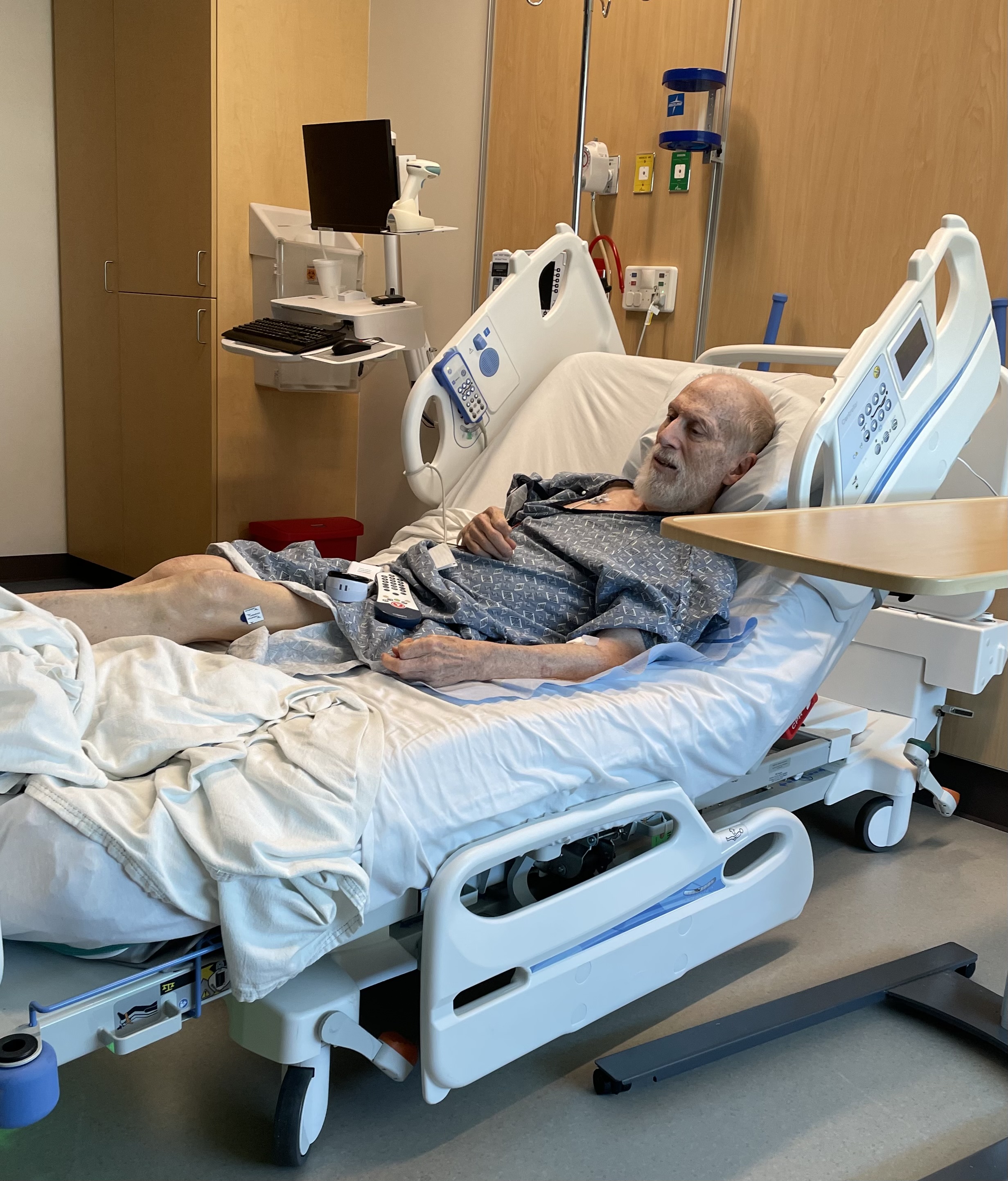
| Recovering from Surgery |
I felt pain more recently when, during that last phone call, I sensed him saying “Goodbye” before going into hospice care. And though it wasn’t a surprise when Rachel contacted me this week to tell me that 93-year-old Maurice had died, quietly and gently, his tender heart simply giving out, it made me gasp, trying to imagine a world without my dear friend.
 |
| Rachel Wahba, Maurice's beloved niece at his recent funeral in San Francisco |
Grieving a close and longtime friend is complicated, even more so when that friend is an ex-lover. There are rituals for families, cards for widows, for surviving adult children and grandchildren, nieces and nephews.
 |
| Maurice's nieces and nephew at his funeral: from right, Rachel Wahba, Rebecca Wahba, Tiffany Wagner and Elliot Wahba |
But there is none of that for someone filled with love and memories but with no official standing in the life of a lover turned lifelong friend.
On one level, it makes perfect sense. I can hear the logical observations now, both from others and in my own head:
“But he was just a boyfriend. And then you were just friends…”
“But you and he broke up nearly 50 years ago…”
“But you both found other loves that were more enduring and sustainable in the years since…”
All of that is true. But Maurice was never a “just” either as a lover or as a friend. He helped me to grow up, learn to trust and stop fearing men. At the same time, he helped me learn to enjoy life with the ease of a child I had never been, singing when happy, being silly, laughing between the stresses of daily living. He was special to me in so many ways and the years since have not diminished his unique place in my heart, even in my 48 years with my husband Bob or his 18 years with Rosemarie.
Unexpectedly, he appeared in my dreams several times in the weeks before he died. And each time, he repeated what he said during our last phone call: that he would love me forever. I had sensed that the end was near.
But what now?
What does one do with the flood of tenderness and pain? Travel back in time to linger with bittersweet memories of long-ago passion? Cry over songs that defined our time together? Reflect with gratitude on the blessing of this once and forever love? Write thoughts, feelings and memories, perhaps for one's eyes only, perhaps for the world to see? Talk with someone who knows you well about someone who mattered so much?
As I sat, feeling sad and overwhelmed, my husband Bob took my hand. “Do you want to talk about Maurice?” he asked me.
I hesitated, surprised and a bit self-conscious about my obvious grief. “He was such a good person,” Bob said. “I had so much respect for him. What an amazing man he was. Let's talk about him and remember. What was he like when you were together? What made your time with him so special? What are your best memories of Maurice?”
I smiled through my tears and squeezed his hand.
I'm amazed these days at how readily one memory can spark another with so many criss-crossing connections over the years.
Reading the newspaper list "Daily Birthday" of celebrities, both major and minor, the other day, I noted that Johnny Tillotson turned 84. Even back in the day, Tillotson was a "B-List" teen idol eclipsed by Elvis, the Beatles, etc. But to some die-hard fans, he was the true king.
My friend Marie Traina, who was the president for life of his national fan club, was his greatest die-hard fan. She described herself as a "perpetual teeny bopper" and, indeed, maintained a youthful, enthusiastic attitude all her life -- whether she was singing Johnny's praises or cheering on Northwestern's basketball team or simply being a caring friend.
But there was a tragic twist to her story: Marie never had the privilege of growing old. She was murdered when she was one month shy of her 29th birthday.
Many other dear friends have passed away since, but Marie was cheated out of many more years of life than the rest of us. I've never stopped being sad for her and have never stopped missing her.
Celebrating my 77th birthday today, I feel incredibly blessed with years, life experience and the people who have brought so much joy to my life.
Beyond the predictable aches and pains and medical issues our advanced years can bring, there is so much to celebrate.
Like what?
Being increasingly comfortable in our own skin. This is a time when we finally make peace with the imperfections of our bodies. When we were young and our bodies closest to perfection, we were, too often, relentlessly critical of ourselves. We thought we were fat when we weren't. We agonized over noses too large or teeth too crooked or hair that refused to conform to a bubble-do.
Too often, we had help from society in our scathing self-assessments. Briefly in my twenties, I pursued an acting career. At 118 pounds and 5'4", I was considered overweight by agents, casting directors and acting coaches. I was even cast in a comic role as the "Fat Dancer" in a musical revival. I hated my body and I wasn't alone. Not long ago, some neighbors and I were comparing photos taken in our twenties. We marveled at how beautiful we all were. But we didn't feel beautiful then. And what a shame we couldn't enjoy our singular beauty -- at any weight or shape or size.
It's easier now to relax and accept what is. There are many days when I actually do feel beautiful. There are many days when I can laugh about wrinkles and bat wings and other unmistakable signs of aging. I worry about and watch my weight only for health reasons.
And I've come to realize that one's worth is intrinsic and has more to do with character than appearance. Didn't we always know that? But we didn't necessarily feel that level of self-acceptance back in the day. We're more likely to be blessed with that acceptance of ourselves as we mature into older age.
Being thankful for the health we do have. Very few of us have not had our health challenges as we've aged. I grew up from a sickly childhood overshadowed by bulbar polio and disseminated histoplasmosis that left me with severely scarred lungs. But in adulthood, I was blessed with robust good health and strength. I danced for many years. I got into running in my thirties. I've enjoyed gym workouts for decades. But there have been hints of new limitations in the past 20 years. I survived thoracic surgery to remove an esophageal growth and the upper lobe of my right lung in 2003. I survived a heart attack later that same year. And in 2020, a temporarily disabling accident kept me immobilized and in a wheelchair for nearly a year.
How wonderful it feels to have a reprieve: to be mobile again and able to walk, bike, swim and get back to the gym; to wake up feeling healthy and hopeful. I know what it is to lose one's mobility and to nearly lose one's life. I no longer take the ability to walk for granted. I welcome every day that dawns, knowing that everything could change in an instant.
Gaining perspective on what truly matters. With age and experience, we learn to filter out what doesn't really matter and to focus on what does. I used to obsess about professional success and getting ahead, building a platform, selling books. To be honest, I still care more about my continuing career than most of my peers, but I'm not obsessive to the exclusion of everything else.
I was talking today with my friend Chuck, a recently retired physician whom I have known for nearly 50 years. Our lives have been intertwined on several levels over the years -- an ill-fated romance when we were young, a successful professional partnership on four books, one of them a best-seller some years back, and an enduring friendship. I told him how I regretted often putting deadlines and other work priorities ahead of people who mattered to me. He sighed and said "I know...I did too..with too many. When it was the people who really mattered most." And we promised that we would focus more going forward on the loved ones in our lives. Some friends are way ahead on this one: I've happily watched some driven professionals of my youth becoming doting grandparents, insisting that these are the best years ever.
Treasuring the loved ones of our youth and welcoming new people into our lives. There is something quite wonderful about having family and friends one has known for years or a lifetime. There is only one adult from my childhood still living: Sister Rita McCormack, a nun who was my brother's first grade teacher and my special friend since I was 8 and she was 23. She turned 92 this past February and, despite some physical frailty, she is the same vibrant spirit who inspired and encouraged me as a child. We have morphed from being teacher and student to being dear friends. She knows how far I've come since then. I know what she has endured and how she has triumphed.
The same is true of many lifelong friends -- some from grade school, high school and college and many from my first job at 'TEEN Magazine -- with whom I shared youth and a full list of "firsts", the highs and the lows, the life experiences and so much growth over time.
Being in a marriage of 45 years is a particular pleasure. Bob and I see each other both as the lively 30 year olds we were when we met and as the gentler and wiser people we've become -- a kind of emotional collage that is both comforting and fun.
Siblings can be immensely comforting, too, the age differences and even the spats of the past blurred by the joy of continuing to be there for each other.
And it's a joy to welcome new people of all ages into our lives: not only the nieces and nephew who bring such love, hope and vitality but also our younger friends who are fun and supportive and patient and some new older friends who are a source of inspiration in aging.
Living fully in the present. Now that we know, with new clarity, that we have many more years behind us than we have years ahead, we have an opportunity to savor life anew. Whether it's the wind on my face as I ride my bike, the scent of jasmine growing outside my office, sudden affection from an often-aloof cat, the taste of a crisp salad or a juicy peach, the sound of a familiar song bringing happy or even bitter sweet memories, birdsong at twilight, a hug from a child, another chance to be kind... In short, everything that each new day has to offer, is an incredible blessing and a reminder that old age is, indeed, a privilege denied to many and that each day can be a celebration.
I've always had a soft spot for black cats. When I was a child, we got our first cat -- a black Angora kitten we named Edie. Edie was a joy to all of us, but had a special love for my sister Tai, only a toddler at the time. Edie would wrap her paws around Tai's neck and hug her. She hugged Tai through some very tough times -- and losing her, when Tai was 14 -- was devastating. Tai and I have both had other cats through the years, all of them special, but our memories of Edie are everlastingly warm.
More recently, my husband Bob and I have treasured our own two black cats: Maggie and Ollie.
Maggie came to us during a time of sorrow. We had lost our beloved Timmy -- one of a bonded pair of brothers -- due to melamine poisoning during the pet food scandal in 2007. Timmy's brother Gus cried all night, every night, for three weeks until our vet suggested getting him a kitten to love and take care of. That kitten was Maggie and Gus loved her at first sight.

Bob felt a special bond, too. Maggie was a sleek, shiny Bombay, a black Burmese who had been dumped into rescue by a Beverly Hills breeder because she was such a homely kitten. She grew into a beautiful cat: loving, smart, kind and protective of Bob. When he would have epileptic seizures or night terrors, she would jump on his chest and put her paws around his neck. Once, when he had a seizure so severe that I called 911, she stayed on his chest, hanging on tight when the paramedics arrived even though she usually rushed to get under the bed when strangers would arrive at the door. Maggie was sweet to me and always seemed mindful that I needed love, too. But Bob was her most special human.


Ollie came to us seven years after Maggie -- a fortunate accident. I was in the L.A. area to promote my book "Purr Therapy" which was about the two cats -- Timmy and Marina --who had worked with me one day a week doing animal assisted therapy in my private practice. At one event -- Catoberfest in Santa Clarita -- there were rescue organizations offering animals for adoption. Taking a break from book signing, I walked outside and then I saw him. He was the poster kitten for unadoptable animals who needed financial support to keep living in rescue. His name at the time was "Herbie the Love Bug" and he was two months old, all soft black fur with a daunting past. He had been mutilated shortly after birth -- his right hind leg mostly severed. He also had a giant hernia. The newborn kitten had been thrown into a trash at the curb but was saved by his big voice -- a resounding yodel that never ceased to startle us -- that alerted a passerby who took him out of the trash and to rescue. He needed some expensive surgeries and was considered a long shot for adoption. I sent my husband a picture of him and Bob replied "Let's take him! Let's give him a good life!"


There were times when we would look over at each other -- Bob cuddling Maggie, me cuddling Ollie -- and tell each other that black cats were magical and wonderful and that life was good.
Life is good, but also fragile.
Maggie's health began to decline rapidly just as she was about to turn 14. She lost a significant amount of weight, suddenly looking skeletal. Always a very proper, well-behaved cat, she began to defecate outside the cat box. We cleaned up after her. We gave her special medication for her thyroid condition. And tried to love her back to good health. But love was not enough to keep her with us...and Maggie passed away in February 2022 just weeks shy of her 15th birthday.
There hasn't been a day that has passed without missing her. Our one consolation has been that our other cats have been healthy and are younger: Sweet Pea is 12, Hamish, 10 and Ollie, 7. I imagined enjoying Ollie's cuddles for many years to come and thought that he would most likely be the last of our surviving three to pass away.
Life can be surprising, strange and cruel.
I spent much of yesterday in bed, suffering flu-like side-effects after getting my second Covid booster shot. Ollie and his best buddy Hamish cuddled with me much of that time. I got up to feed them about 5 p.m. last night, noting that all three cats were eating their dinner enthusiastically. I returned to bed and fell asleep. When I woke up several hours later, I saw Ollie lying across the threshold of the bedroom door. I called to him, expecting his usual response: to make a running jump onto the bed and into my arms. But he was still. I moved closer. I spoke his name. I petted him and cupped his head in my hands. His neck was limp. His pupils were dilated. He wasn't breathing. Ollie was gone.
We were totally shocked. He hadn't shown any signs of illness or distress. He had had an ordinary day and a hearty dinner. Bob held him tenderly in his arms, telling him how much we loved him and what a wonderful cat he was. Part of this was saying "goodbye" but part was disbelief. How could he be so suddenly, inexplicably gone? Once again, we were quietly hoping love would overcome the inevitable. We checked and re-checked, hoping against hope that this was all a mistake, a misunderstanding, a bad dream. But he lay still in Bob's arms.
And so, in an instant, another magical black cat has become a memory. But, oh, what memories! And how blessed we were to have these two unforgettable black cats in our lives.


The signs of increasing incivility have made the news during these pandemic years: the surly passengers on airlines verbally and physically attacking flight attendants, the confrontations in public places over masking, the shouting matches at school board meetings. I've seen hints of toxic behavior myself lately: the guy in front of me in a grocery line who swore not so quietly when the frail elderly woman ahead of him was taking longer to pay and exit than he would have liked; the Karen at a fast food restaurant who berated the frazzled young woman at the counter for pausing as she counted out her change.
And I had a close encounter with such toxic impatience this morning as I was driving my husband Bob to a Phoenix hospital at 5:30 a.m. for surgery. It was a cold, very dark predawn morning. Since the pandemic has limited our social activities including theatre going, I haven't driven any significant distance at night for several years. What I noticed this morning, with some alarm, was that my night vision has deteriorated significantly. I struggled to see lane lines, especially in the glare of oncoming headlights in the early morning commuter traffic to Phoenix. Usually a fast and confident driver, I stuck to the speed limit this morning and, on occasional sharp curves, slightly below the speed limit.
On one of these curves, on a busy freeway interchange, it happened. A car roared past me on the right shoulder of the road, just at the sharpest point in the curve. Then the driver cut in front of me and slammed on his brakes. I had to brake suddenly and hard to avoid a collision. Fortunately, no one was following close behind me. The toxically impatient driver, having made his point, sped off. And I continued on to the hospital, my hands uncharacteristically slick with sweat and shaking on the steering wheel.
"Road rage," Bob said, exhaling slowly, his surgery anxiety temporarily secondary to his concern about our safety on the road.
It could have been catastrophic if I hadn't been able to stop in time, if the person behind me had been tailgating. I was driving my small Honda Fit amid hulking SUVs and now was feeling suddenly vulnerable. I've driven this little car solo between my home in Arizona and Los Angeles many times, cruising comfortably at top speed among semi-trucks for the full 500 miles. But I've always taken my long driving trips during daylight hours sharing the road with truckers and vacationers rather than pre-dawn commuters. I've heard of road rage incidents, but have never experienced one until now.
I wondered how much time our road rager really saved by passing me and if making his point felt worth the considerable risk.
When we got to the hospital, we saw huge signs both in the admission and the pre-surgical waiting areas:
"THIS HOSPITAL IS A HEALING PLACE. WE WILL NOT TOLERATE DISRUPTIVE, RUDE BEHAVIOR."
And I felt sad that such warnings were necessary.
When did we start getting so toxically impatient with rules and with each other?
When did some people decide to punish and terrify a slower driver rather than simply sigh and change lanes? When did common courtesy and civility in public places slip into churlishness and worse? When did compassion and respect for differences start to disappear?
I've been thinking about how much energy it takes to be angry and oppositional, to judge and humiliate rather than take a deep breath and try to understand.
Yes, other people can be annoying whether they're taking longer at the cash register or driving slower on the road. The elderly person walking slowly with a cane down a parking lot aisle can hold you up for a minute or two. The young mother with a screaming toddler in tow in a grocery line almost certainly wishes even more than you do that her child would calm down. Is an annoyance worth cursing, road rage, honking, dirty looks or hurtful words?
What if we could, more often than not, manage patience and compassion? Would it ruin our day to let a mother with a crying child go ahead of us in the line? Or wait as an old person, walking heavily on a cane to his car, temporarily blocks our way to a prime parking spot? After all, most of us have suffered through our own past experiences with toddlers having public meltdowns. And most of us are or will be old someday. A bit of empathy can spare the nerves on both sides.
At the same time, knowing or imagining a raging person's back story can help us to calm down and move on. I'm trying to imagine how the day started for the person who risked our lives and his with his road rage this morning. Perhaps he was transitioning from a miserable home life to a job he hates, frantic to be on time. His toxic impatience may be making his life difficult at every juncture and rather than look inward, he blames everyone else. One could call him an asshole or a jerk. But angry labels can't fully explain such behavior or help to soothe one's spirit in the aftermath.
Now that my hands have stopped shaking, now that Bob's surgeon has let me know that his thyroid surgery went well and that, after an overnight stay, he will be ready to come home tomorrow, I think about our earlier brush with road rage from a more measured perspective.
I need to see my ophthalmologist about my impaired night vision and avoid driving at night or in the predawn hours whenever possible. I need to forgive that rage-filled driver for my own peace of mind and be thankful that I have never encountered anyone like him before in my sixty years of driving -- much of it in fierce L.A. traffic. And I need to let gratitude suffuse my spirit: that I avoided the accident, that Bob is recovering, that I am safely home.
In a lovely column recently, E.J. Montini of The Arizona Republic, recounted his first Christmas with his beloved wife many years ago when they were just starting out in life, too poor to buy lights or ornaments for their little Christmas tree. So they decorated it with popcorn strings and ornaments cut out of construction paper. And his wife, who passed away last year, always said that it was the best Christmas ever.
As he braced himself for his first holiday without her, a reader who was also a recent widower sent him a comforting note. The reader told him that he had remarked to family members that, in his grief, he was convinced that there could be no "happily ever after." His young granddaughter piped up with "What about 'happily ever before'?" The concept resonated with him and with Mr. Montini, too, who found comfort in warm holiday memories of that long ago tiny apartment, the popcorn decorated tree and the love and hope that made his first married holiday so special.
The idea of focusing on our "happily ever before" in dark moments or as we age and lose so many beloved friends and family members as well as certain aspects of ourselves isn't a matter of living in the past. It is more like savoring moments from the past -- moments that may not have seemed quite so positive at the time -- to complete a warm and largely positive life summary that is comforting in the present.
Looking back, what were the events, the people, the situations that were challenging at the time that now spark joy as you look back? In the past, what made you feel comfort? Who brought love to your life? What and who made you laugh? What have you learned from adversity? When you view the long narrative of your life -- the pleasures, the disappointments, the devastating moments and the learning experiences -- what is your overall feeling?
Tapping into our "happily ever before" moments may be especially useful now as we head into our third pandemic year, perhaps impatient with restrictions, perhaps yearning for that time before that seems increasingly distant. We have a choice between comparing then and now and finding the present wanting or letting the lovely memories and perspectives of life before give balance to our lives at a challenging time. We have a choice, too, if our "before" times were rough, between clinging to the sorrow that was and allowing it to overshadow the joy that could be or focusing on the positive aspects of life in the past.
For many of us, our lives have been bittersweet, with an abundance of ups and downs. If we can look back and find the joy between the pain, the humor that can bring light to some dark times, we may find more sweet than bitter in both past and present.
I know.
Growing up with a mentally ill, abusive, alcoholic father was not easy nor was it fun having a mother who was too frightened and passive to protect my brother, sister and me from abuse and too focused on my external imperfections ever to know me well. But for all the stress and tears and frightening times, I remember my father's humor, charm and genuine caring during his sober moments and my mother's enthusiasm for my dreams and her encouragement of my close relationship with Aunt Molly, my father's bright, career-oriented sister who never married or had children but whose life was incredibly full. My brother Michael, sister Tai and I never knew which version of our father we would encounter when walking in the door, but we agree that we would not have wanted to grow up without each other or without our sometimes caring, sometimes distressing family of origin. We remember laughter as well as pain, intellectual curiosity and impassioned discussions as well as moments of despair and a sense of being loved amidst the chaos and terror of our shared childhoods.
There is baggage, to be sure, but there is so much else, too: an appreciation for nuances and the complexity of human beings and an inclination to keep moving ahead. None of us were tempted to extend our adolescence as some do, living with parents into young adulthood, putting off learning to drive, not focusing on the future. We were out into the world and on our different life paths early on. We worked our various ways through school. And eventually we all found ourselves in helping professions: my brother as a physician, my sister as a nurse and myself as a psychotherapist and writer of self-help books and articles. We look back on an increasingly distant past as a time filled will humor and horror, valuable life lessons, and guerrilla training in resilience and in compassion.
As I contend with the isolation and intermittent loneliness of the pandemic, I am comforted by both present realities and warm memories of loving relationships. I treasure family relationships and those of friends, especially those relationships stretching back in time to a shared youth. My loved ones all live at a distance, all in different states. The visits we once enjoyed have been precluded by pandemic realities, but we're warmed by the memories we've made together: long talks with my treasured friend Mary; celebrating some holidays and life in general with my beloved friend Tim; laughing with and enjoying the support of my college friends Georgie and Jeanne and their wonderful husbands; sharing so many feelings and experiences with Pat, my friend since kindergarten; savoring the Maui surf with my sister Tai, who remembers our time together there as "the absolute happiest week of my life!"; delightful discussions with my brother Mike, fun times with his wife Jan and his children Maggie, 12 and Henry, 9, who are growing up to be truly good people.
I also enjoy happily ever before memories of relationships lost: my cousin Caron, whom I loved and admired all her life; my first serious boyfriend Mike, a wonderfully kind and gentle man whom I took for granted fifty years ago and whose upbeat letters and quiet emotional support I have missed greatly since his death in 2018; the caring and enduring relationships with three college roommates Cheryl, Lorraine and Lorene who all died way too soon; the joy of singing with my friend Marie, who taught me to open my throat and my heart in song, and who, tragically, was murdered while still in her twenties; and Elizabeth Swayne Yamashita, my most demanding college journalism professor who became a lifelong mentor and beloved friend.
Especially now, as I face the losses and limitations of aging, I find comfort in my long marriage with Bob and in our memories of our younger selves -- memories of getting up before dawn to run several miles together, of discovering each other's favorite music together, of adopting our first cat Freddie who was a great life companion for seventeen years, of making a home together. It is immensely comforting to be with someone who remembers my young, vigorous self who could run for miles and who danced into young middle age. And he can laugh ruefully with me at the present surprise of our age-related limitations.
And I think "What a blessed life I have had and have to this day!"
The comfort and wisdom gleaned from our "happily ever before" times can help us through the uncertainties of the present. This is a time of political and philosophical divisiveness. It is a time of a pandemic that threatens our health and our lives. It is a time, for many of us, when most of our lives are in the past with less time left in the future to continue to savor life and new discoveries and to watch with wonder as new generations come of age.
And yet...add up the blessings of the happily ever before times and our imperfect present: we have lived more joyously than not, more fully than we once imagined possible. And we have loved, enjoying so many complex and wonderful variations of love in our lives!

